What to Check Before Paying for an Email Marketing Platform
Trying out email marketing tools before committing is a must for any business. You want to be confident the platform actually fits your needs, matches your technical skills, and won’t become a financial burden as you grow. The easiest way to evaluate this is by using a free plan or trial. Most platforms offer one, but the features you can test often differ quite a bit. That’s why it’s important to know what to look for before making a decision. Here are the key things worth paying attention to.
Dina White
4/9/20263 min read
Ease of use
This one really comes down to personal preference and how comfortable you are with tech. Still, for most people, usability is a deal breaker. If a platform feels confusing, it will be hard to get results from it.
Start by exploring the interface. Move around the dashboard and try to find the features you will actually use. Some platforms are built with ecommerce in mind, while others lean more toward B2B or creators. You will quickly feel whether it suits your workflow.
Make sure to check the essentials like campaigns, automation, segmentation, forms, and reporting. These are the backbone of any email marketing tool, so they need to work smoothly.
Templates are another big plus. Whether it’s for newsletters, automations, or audience segments, having ready made templates can save a lot of time. You can launch faster and then customize things later as needed.
If your business requires very advanced setups like highly detailed segmentation or complex automation flows, you may need to sacrifice some simplicity. Tools that offer deep functionality are rarely the easiest to use. But for most businesses, simpler setups work perfectly fine. Often, a small amount of effort brings most of the results.
AI features
AI can seriously speed things up inside an email platform. It can help you write faster, build campaigns quicker, and reduce manual work.
Most platforms already offer AI for copywriting, but some go further. One feature that really stands out is AI powered segmentation. For example, while testing Omnisend, we found a tool where you can create audience segments just by typing what you want.
Let’s say you want to target your VIP customers who have not purchased in the last six months. Instead of manually setting filters, you simply describe that audience and the segment is created for you almost instantly. Normally, this could take quite a bit of time to set up.
There is also AI that can generate pop up forms, including design and text, based on a simple prompt.
When testing platforms, definitely try these features. They can save hours of work. Keep in mind that not all tools allow access to AI features on free plans, but some do, which makes them much easier to evaluate properly.
Customer support
Good support can make a huge difference, especially when you are learning a new system. Without it, even small issues can become frustrating.
Check what support channels are available. Some platforms only offer email support, while others include live chat. Live chat is usually the most convenient if you need quick answers. Email responses can take longer, which may slow you down.
Phone support can sound appealing, but it is not always a positive. In some cases, it is tied to less flexible processes. For example, some providers require you to call them to cancel your subscription, instead of letting you do it yourself online.
Before choosing a platform, it is worth checking how easy it is to cancel a free trial. You do not want to get stuck in a situation where stopping your subscription becomes unnecessarily complicated.
Pricing
For many businesses, pricing is the deciding factor. At first glance, most platforms seem similarly priced, but the real difference shows as your contact list grows.
It is also important to look at how pricing plans are structured. Platforms with too many tiers can become frustrating. You might find yourself upgrading constantly just to unlock basic features.
Ideally, look for a provider with a simple structure like free, standard, and pro. Larger businesses can benefit from enterprise plans, but anything more than that can get confusing and expensive over time.
Here is an example of how pricing can change as your audience grows:
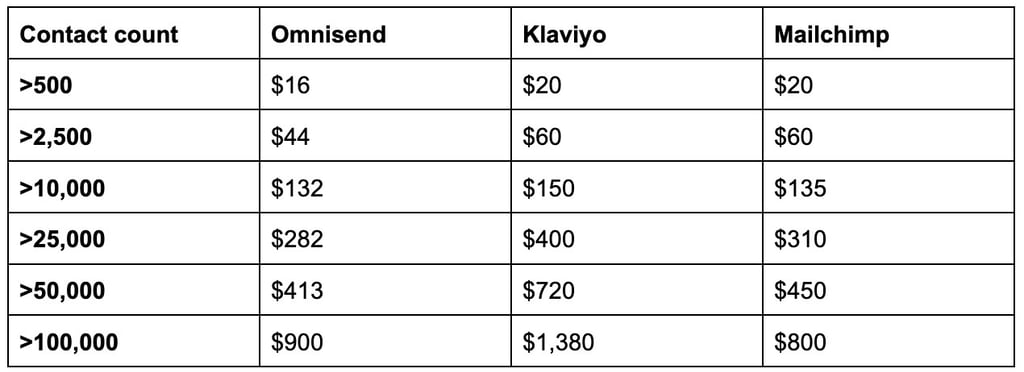
Also, avoid paying for features you do not actually need. Platforms packed with advanced capabilities may seem attractive, but they often become expensive as you scale.
Final thoughts
Choosing an email marketing platform is not something to rush. The tool you pick will likely stay with you for years, and switching later can be complicated and costly.
Take time to explore the platform properly. Test the interface, automation, templates, support, AI tools, and pricing. Look for a balance between ease of use and functionality. Platforms like Omnisend, for example, make it easier to evaluate everything in one place since many features are accessible even on the free plan.
It is tempting to go for the most advanced solution, but in many cases, a simpler tool that fits your needs will deliver better results without draining your budget.
Start by clearly defining what your business actually needs. Then choose the platform that delivers those essentials in the most efficient and cost effective way.